

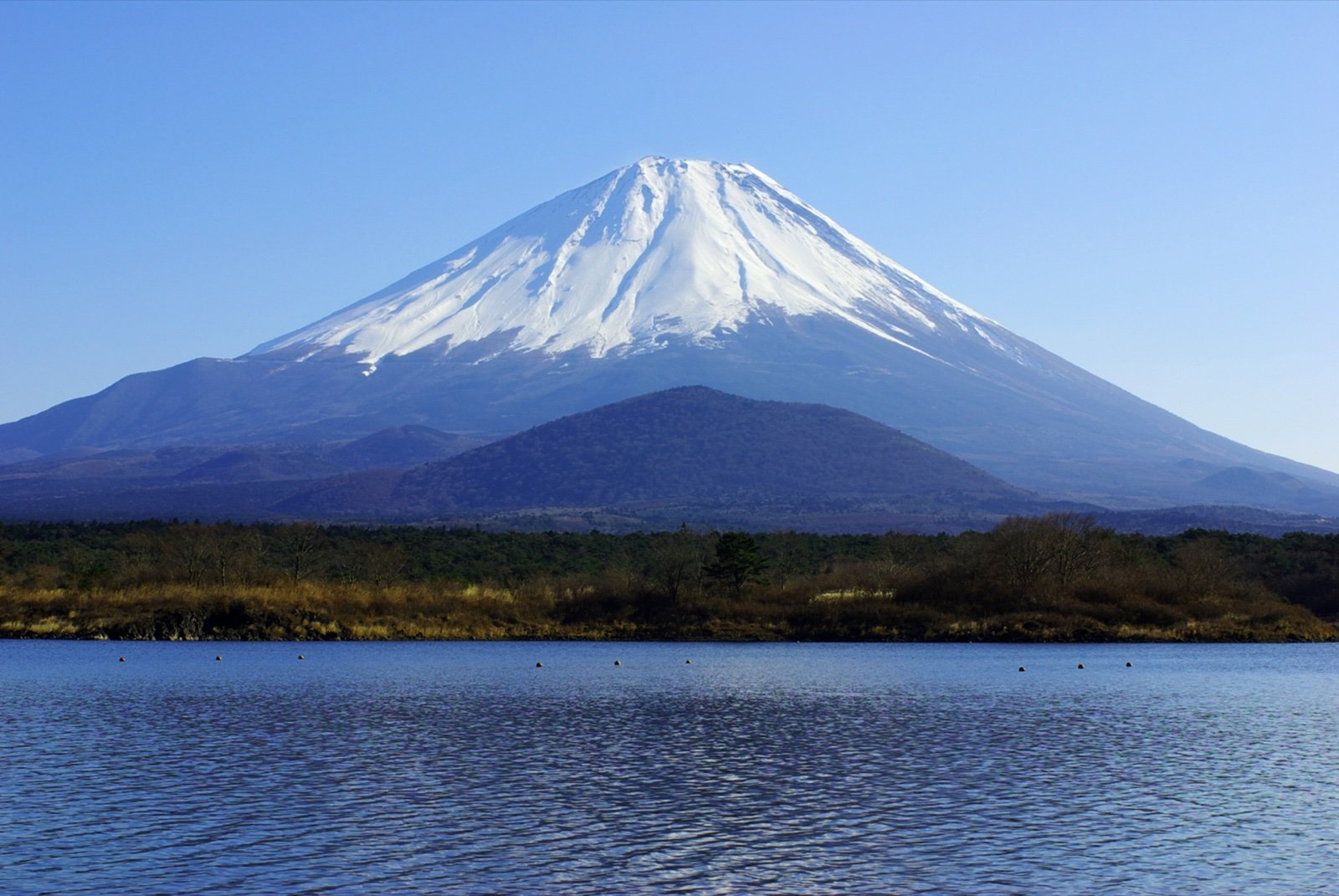
Mount Fuji
A 3,776 m stratovolcano straddling Shizuoka and Yamanashi, climbed by four trails from the fifth stations. The 2026 season ended on 10 September: outside the season, every route to the summit is closed.
- 12,388 ftElevation
- 205,100Visitors in 2025
At a glance
- 3,776 m, a classic stratovolcano on the border of Shizuoka and Yamanashi
- On the World Heritage list as a cultural site since 2013
- Four trails to the summit, each starting from a fifth station between 1,440 m and 2,400 m
- Season 2026: 1 July to 10 September on Yoshida and Subashiri, from 10 July on Fujinomiya and Gotemba
- A ¥4,000 passage fee and an online registration for every climb in season
- 205,100 climbers counted at the eighth station in 2025
Where to stay
Hotels, guesthouses and rentals around Mount Fuji
Check availability with our partners
Affiliate links: if you book through them, we earn a commission. The price you pay does not change. How this site is funded
FujiyoshidaClosest
10 mi as the crow flies
See hotelsFujinomiya
11 mi as the crow flies
See hotelsGotemba
12 mi as the crow flies
See hotels
Which tour to choose?
| Tour | Duration | Length |
|---|---|---|
| 富士宮ルート | 5 h | 2.7 mi |
| 御殿場ルート | 9 h | 6.5 mi |
| 須走ルート | 7 h | 4.3 mi |
| 吉田ルート | 6 h | 4.2 mi |
Facts checked on October 15, 2026
Tickets and prices
| Admission, Everyone | 4,000 JPY |
|---|
Source: Conseil de promotion de la sécurité du mont Fuji (fujisan-climb.jp)
How the visit runs
Register and pay before you leave
Every climber registers through the web system and pays the ¥4,000 fee. Registration is not a hut booking; on the Yoshida trail, the ticket is chosen for the date you pass the fifth-station gate.
Start from a fifth station
The four trails, Yoshida, Subashiri, Gotemba and Fujinomiya, all begin at a fifth station. On Yoshida, a gate there controls who goes up.
A night in a mountain hut
A night in a mountain hut is advised, and some fill very early, the highest ones first. Tents are not allowed on the mountain.
The summit and the crater circuit
The crater circuit opened with the Fujinomiya and Gotemba trails, on 10 July in 2026. Above the 8.5th station, the land belongs to the Fujisan Hongū Sengen Taisha shrine.
The way down
Fujinomiya comes down by the same rocky path, 4.3 km in about 3 h. The other descents run 7 km on Yoshida, 6.2 km on Subashiri and 8.4 km on Gotemba, about 4 h each.
Mount Fuji’s four trails compared
| Trail | Prefecture | Start | Season 2026 | Character |
|---|---|---|---|---|
| Yoshida | Yamanashi | Subaru Line fifth station, 2,305 m | 1 July to 10 September | Gate at the fifth station, cap of 4,000 a day |
| Subashiri | Shizuoka | Fifth station, 2,000 m | 1 July to 10 September | Forest, then volcanic gravel |
| Gotemba | Shizuoka | New fifth station, 1,440 m | 10 July to 10 September | The longest: 10.5 km up |
| Fujinomiya | Shizuoka | Fifth station, 2,400 m | 10 July to 10 September | The shortest and highest start, rocky, 1,320 m of ascent |
Source: official Mount Fuji climbing site and Shizuoka trail pages (2026).
Before you go
- Mandatory kit: mountain boots, two-piece rainwear and warm clothing. Your equipment may be checked at the entrance.
- Cold at the top: the summit drops close to 0 °C before dawn, even in summer.
- Cash: there is no cash machine at the Yoshida fifth station. The fee takes cards and mobile payment, but bring cash before you arrive.
- Rubbish: there are no bins on the trails or in the huts. Carry everything down, and bring a portable toilet.
- Stones: taking even a pebble is not allowed, nor is moving stones.
- Dogs: climbing with a pet is discouraged, pets are not admitted in the huts, and the volcanic ground hurts their paws.
- Drones and paragliders are banned above the 8.5th station by the shrine that owns the land.
- Private cars: in 2026 the Fuji Skyline (Fujinomiya) and the Fuji Azami Line (Subashiri) were closed to them during the season; shuttles and taxis run instead.
- Crowds: late July to late August is the peak, above all at weekends and during Obon.
What is allowed
| Topic | Rule | Source |
|---|---|---|
| Camping | Not allowed | Conseil de promotion de la sécurité du mont Fuji (fujisan-climb.jp) |
| Fires | Not allowed | Conseil de promotion de la sécurité du mont Fuji (fujisan-climb.jp) |
| Dogs | Restricted | Conseil de promotion de la sécurité du mont Fuji (fujisan-climb.jp) |
| Drones | Restricted | Conseil de promotion de la sécurité du mont Fuji (fujisan-climb.jp) |
| Motor vehicles | RestrictedJuly to September | Conseil de promotion de la sécurité du mont Fuji (fujisan-climb.jp) |
| Picking plants | Not allowed | Conseil de promotion de la sécurité du mont Fuji (fujisan-climb.jp) |
| Visitor quota | Restricted | Conseil de promotion de la sécurité du mont Fuji (fujisan-climb.jp) |
Rules checked with the site manager on October 15, 2026. They can change at short notice: check before you go.
When to go
- Busiest period July to August
How to get there
Mount FujiGateway towns
Mount Fuji sits where three tectonic plates meet: the Eurasian, the North American or Okhotsk, and the Philippine Sea plate, while its magma comes from the Pacific plate. Japanese Wikipedia calls it a typical stratovolcano; it rises to 12,388 ft.
Asleep since 1708, still watched
The mountain has not erupted for more than three centuries, but it keeps its active status:
- 16 December 1707 to 24 February 1708: the Hōei eruption, the last one recorded.
- 8 October 2026: the Japan Meteorological Agency’s monthly bulletin keeps the eruption forecast at alert level 1, with a reminder that Fuji is an active volcano.
A holy mountain ringed by towns and lakes
Fuji is one of Japan’s Three Holy Mountains, and it entered the World Heritage list on 22 June 2013 as a cultural property, not a natural one. The top of the mountain is shrine land. Four small cities surround the base:
- Fujiyoshida to the north, at the foot of the Yoshida trail;
- Gotemba to the east, start of the Gotemba trail;
- Fujinomiya to the southwest, for the Fujinomiya trail;
- Fuji to the south.
Five lakes surround it: Kawaguchi, Yamanaka, Sai, Motosu and Shōji.
Wind and cold above 3,000 metres
Above 9,843 ft the climb is a high-mountain outing, with wind and temperatures to match, even in July. The official climbing site gives two rules of thumb:
- the air cools by about 0.6 °C for every 328 ft of ascent;
- each metre per second of wind takes off about 1 °C more in felt temperature.
Most climbers aim to see sunrise from the summit, so the path just below the top is often jammed before dawn. The official site warns that forcing a way past in a queue can cause falls and rockfall, and asks climbers to spread out, for instance by avoiding weekends.
How many climb, and how they are counted
Japan’s Ministry of the Environment has counted climbers on all four trails since 2005, using infrared counters at the eighth station:
- 2009: more than 300,000 climbers, according to Wikipedia;
- 2019: about 236,000;
- 2024: 204,316;
- 2025: 205,100, a stable level and 87% of 2019. Counter failures left a few days without data, completed from the inspection register.
Frequently asked questions
Can you climb Mount Fuji in October?
No. The 2026 season ended on 10 September, and outside the season every trail to the summit is closed. Climbing then breaks article 46 of the Road Act, with up to six months in prison or a ¥300,000 fine.
When is the Mount Fuji climbing season?
In 2026 it ran from 1 July to 10 September on the Yoshida and Subashiri trails, and from 10 July to 10 September on Fujinomiya and Gotemba. On 15 October 2026 the 2027 dates had not been published.
How much does it cost to climb Mount Fuji?
¥4,000 per climber in 2026, a passage fee charged on all four trails, with online registration beforehand.
How long does it take to climb Mount Fuji?
About 5 hours up on the Fujinomiya trail (4.3 km), the shortest, and about 9 hours on the Gotemba trail (10.5 km), the longest. Yoshida takes about 6 hours and Subashiri about 7.
Is there a limit on the number of climbers?
Yes, on the Yoshida trail: 4,000 people a day. Beyond that cap, or between 14:00 and 03:00, the fifth-station gate lets through only climbers with a hut booking.
Can you camp on Mount Fuji?
No. Pitching a tent is not allowed, and fires are banned: you sleep in a mountain hut.
Is Mount Fuji still an active volcano?
Yes. The Japan Meteorological Agency keeps it at eruption alert level 1, noting that it is an active volcano. Its last eruption ran from December 1707 to February 1708.
Sources
12 sources
- Conseil de promotion de la sécurité du mont Fuji (fujisan-climb.jp) consulted on October 15, 2026
- 富士登山オフィシャルサイト(富士山における適正利用推進協議会) consulted on October 15, 2026
- Agence météorologique japonaise (JMA) consulted on October 15, 2026
- JNTO (Organisation nationale du tourisme japonais) consulted on October 15, 2026
- Ministère de l'Environnement du Japon consulted on October 15, 2026
- OpenStreetMap consulted on October 15, 2026
- Wikidata consulted on October 15, 2026
- Wikipedia de consulted on October 15, 2026
- Wikipedia en consulted on October 15, 2026
- Wikipedia es consulted on October 15, 2026
- Wikipedia fr consulted on October 15, 2026
- Wikipedia ja consulted on October 15, 2026