



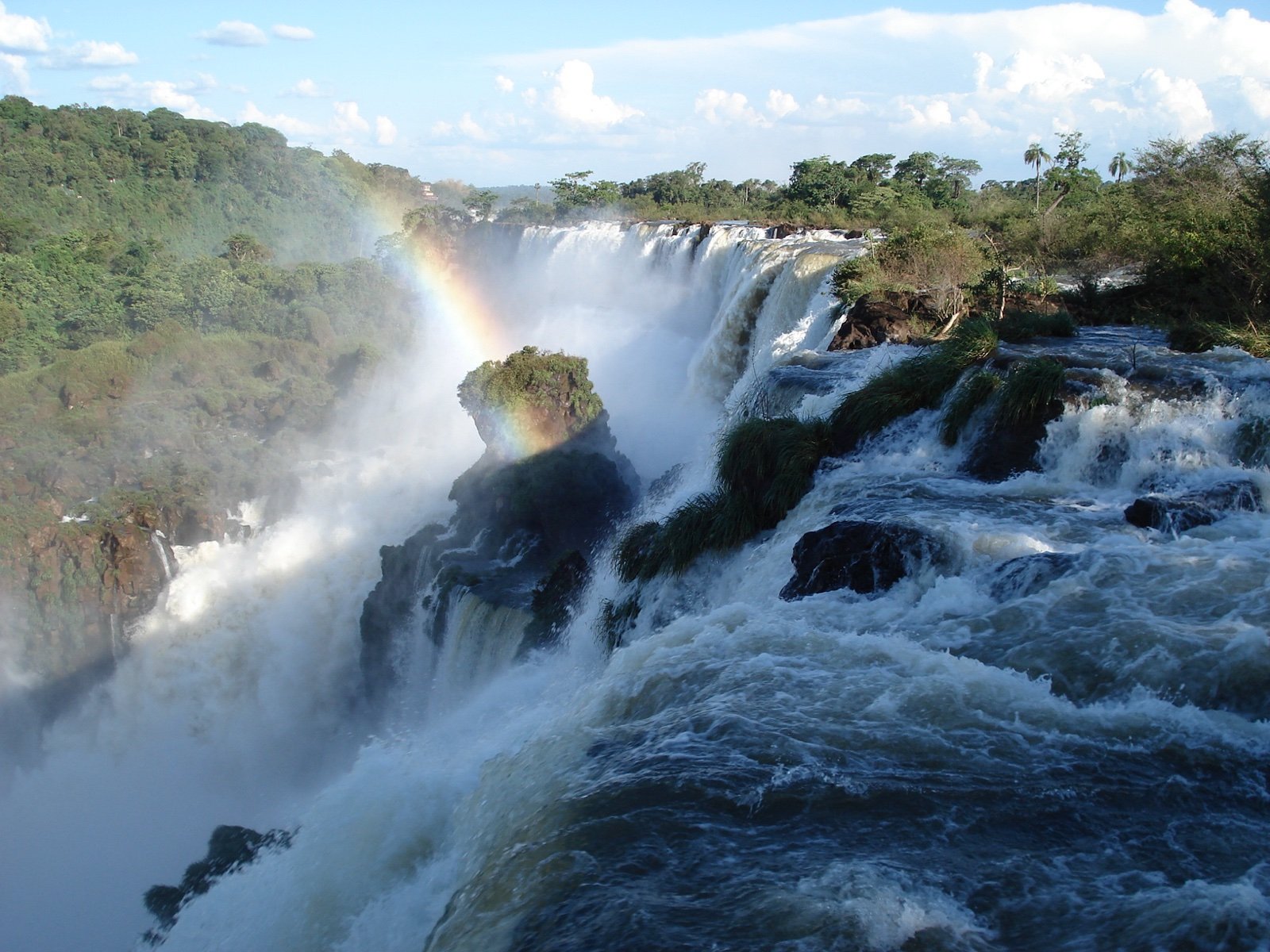
Iguazu Falls
About 275 falls along 2.7 km of the río Iguazú, shared by Argentina and Brazil: the Garganta del Diablo, three Argentine circuits, a forest train, and a Brazilian trail that ends at the Devil’s Throat.

At a glance
- About 275 falls along 2.7 km of the río Iguazú
- Close to 80% of the falls lie on the Argentine side
- The Garganta del Diablo, a U-shaped canyon that takes about half the river
- A Tren Ecológico de la Selva with three stations, included in the Argentine ticket
- Foreign visitors pay 60,000 ARS in Argentina, as displayed in October 2026
- Brazilian tickets are sold online only, for a set day and entry time
Where to stay
Hotels, guesthouses and rentals around Iguazu Falls
Check availability with our partners
Affiliate links: if you book through them, we earn a commission. The price you pay does not change. How this site is funded
Puerto IguazúClosest
11 mi as the crow flies
See hotelsFoz do Iguaçu
14 mi as the crow flies
See hotels
Which tour to choose?
| Tour | Duration | Length | Difficulty |
|---|---|---|---|
| Circuito Garganta del Diablo | 10 min | 1.4 mi | Easy |
| Circuito Inferior | 1 h 30 min | 1.8 mi | Moderate |
| Circuito Superior | 1 h 30 min | 2.3 mi | Easy |
| Sendero Macuco | 3 h | 4.7 mi | Moderate |
| Trilha das Cataratas | 2 h | 0.9 mi |
Facts checked on October 14, 2026
Tickets and prices
| Admission, Adult | 60,000 ARS |
|---|---|
| Parking, Per vehicle | 12,500 ARS |
Source: Iguazú Argentina (concesionaria Área Cataratas)
How the visit runs
Into the Área Cataratas
The Tren Ecológico de la Selva links Estación Central, Estación Cataratas and Estación Garganta. On foot, the Sendero Verde covers the 650 m from the Patio de Servicios to Estación Cataratas through the forest.
Circuito Superior 3,700 m return
About 90 minutes above the falls, with views over Dos Hermanas, Bossetti, Adán, Eva, Mbiguá and San Martín. The whole route takes wheelchairs.
Circuito Inferior 2,900 m return
About 90 minutes closer to the water, past the Lanusse and Álvar Núñez falls, Salto Chico and Dos Hermanas. Steep stairs on some stretches, with an adapted path over 70% of the route.
Garganta del Diablo 2,200 m return
From Estación Garganta, a walkway leads to a balcony on the edge of the Devil’s Throat. Without the train, it is a 40-minute walk of 2,300 m from Estación Cataratas.
Brazilian side: Trilha das Cataratas about 1.5 km
A trail lined with viewpoints that ends on the walkway facing the Garganta do Diabo. The classic visit, with the park shuttle, lasts about two hours.
Iguazu from the Argentine side or the Brazilian side
| Side | Opening | Tickets | Main walk | Gateway town |
|---|---|---|---|---|
| Argentina: Parque Nacional Iguazú | Every day, 8:00 to 18:00; last entry 16:00 | Online from 30 days ahead, or in pesos at the ticket office; foreign visitor 60,000 ARS, train included | Circuito Superior, Circuito Inferior, Garganta del Diablo, Sendero Macuco | Puerto Iguazú, 18 km; Río Uruguay bus every 20 minutes |
| Brazil: Parque Nacional do Iguaçu | Every day; entry 9:00 to 16:00 on weekdays, 8:30 to 16:00 at weekends; closes 17:30 | Online only, for a set day and entry time; foreign visitor from 131 BRL | Trilha das Cataratas, about 1.5 km, about two hours with the shuttle | Foz do Iguaçu, about 20 km; bus 120 from the TTU urban terminal |
Source: Iguazú Argentina and Parque Nacional do Iguaçu, visitor pages; prices as displayed in October 2026.
Other trails on the Brazilian ticket
| Trail | Length | Note |
|---|---|---|
| Caminho do Poço Preto | 9 km (19.2 km return) | Through the Atlantic Forest, on foot or by bike |
| Trilha Ytepopo | 5 km | |
| Circuito São João | 2.8 km | River bathing and a waterfall |
| Trilha da Canafístula | 2.2 km | |
| Ciclovia das Cataratas | 11.6 km | Cycle path |
Source: Parque Nacional do Iguaçu (October 2026). The Caminho das Bananeiras is temporarily closed.
Before you go
- Rain gear: the Argentine circuits stay open in the rain, and the Brazilian walkway takes a constant drizzle; a raincoat is advised on both sides.
- Brazilian entry slot: you book an entry time, not an exit time, and the park closes completely at 17:30.
- Train ticket: the Tren Ecológico is free, but its ticket is collected on site; trains run every 20 to 30 minutes (15 in high season).
- Pets are banned in both parks; Argentina has six free, shaded kennels next to the car park.
- Wildlife: stay on the trails and never feed the animals, coatis included.
- Reduced mobility: free wheelchair loans at the train stations and a free golf cart in Argentina; pushchairs for children up to 2 are for hire at the entrance.
- Parking: 12,500 ARS a day for a car in Argentina, 65 BRL a day for a car or motorbike in Brazil, as displayed in October 2026.
- Sendero Macuco: no services on its 7.6 km, and the rangers decide each day whether it opens, depending on the weather.
What is allowed
| Topic | Rule | Source |
|---|---|---|
| Dogs | Not allowed | Iguazú Argentina (concesionaria Área Cataratas) |
| Strollers | Allowed | Iguazú Argentina (concesionaria Área Cataratas) |
| Motor vehicles | Restricted | Urbia Cataratas (Parque Nacional do Iguaçu) |
Rules checked with the site manager on October 14, 2026. They can change at short notice: check before you go.
How to get there
Iguazu FallsGateway towns
- Puerto Iguazú bus terminal18 kmIguazu Falls
Río Uruguay buses every 20 minutes to the Área Cataratas, Ruta Nacional 101, km 142.
- Cataratas del Iguazú airport6 kmIguazu Falls
The airport lies 6 km south of the falls and 16 km south-east of Puerto Iguazú.
- Foz do Iguaçuabout 20 kmIguazu Falls
Bus 120 Parque Nacional-Aeroporto from the TTU urban terminal to the Brazilian park, BR-469 km 18; the same line runs back.
- Estación Cataratas40 min · 2,300 mIguazu Falls
Footpath to the Garganta del Diablo circuit, for visitors who skip the train.
About 275 separate falls drop along 1.7 mi of the río Iguazú (Iguaçu in Portuguese), where the Argentine province of Misiones meets the Brazilian state of Paraná. Close to 80% of them lie on the Argentine bank, and the border between the two countries runs through the Garganta del Diablo.
Basalt steps and the Devil’s Throat
The front of the falls draws an inverted J 1.7 mi long, of which about 2,953 ft carries no water at all. Its staircase profile comes from the rock underneath:
- Three layers of basalt from the Serra Geral formation, which give the falls two steps of 35 and 131 ft.
- An erosion front that moves back upstream by 1.4 to 2.1 cm a year.
- The Garganta del Diablo (Devil’s Throat), a U-shaped canyon 492 ft wide and 2,297 ft long that swallows about half of the river’s flow.
- A mean annual flow of about 61,801 ft³/s, and a record of 1,613,882 ft³/s measured on 9 June 2014.
The count of individual falls is never fixed: depending on the level of the river, it ranges from 150 to 300.
From “big water” to two national parks
The Guaraní called the river Iguazú, “big water”, from y (water) and ûasú (big). Recognition and protection came in stages:
- 1542: Álvar Núñez Cabeza de Vaca, the first European to see the falls, names them Saltos de Santa María.
- 1934: Argentina creates the Parque Nacional Iguazú, the second national park in the country.
- 10 January 1939: Brazil creates the Parque Nacional do Iguaçu on the opposite bank.
- 1984 and 1986: UNESCO inscribes the Argentine park, then the Brazilian one, on the World Heritage list.
- 11 November 2011: the falls receive the title of a natural wonder of the world.
The Argentine park protects more than 67,000 ha of the Selva Paranense, the Paraná forest ecoregion, and is listed as an important area for bird conservation.
Two parks, two currencies, one border
Each bank is a separate visit, with its own ticket, timetable and gateway town. In Argentina the Administración de Parques Nacionales sets the rules and the concession Iguazú Argentina runs the services; in Brazil the park reports to ICMBio, with Urbia Cataratas as concessionaire.
- Puerto Iguazú, 11 mi from the falls, has built much of its infrastructure around tourism; the Cataratas del Iguazú international airport lies 3.7 mi south of the falls.
- Foz do Iguaçu, on the Brazilian side, is about 12 mi from the park, and its airport sits between the town and the park.
- In the Brazilian park, private cars stay outside: only accredited tourist vehicles drive in, under a speed limit set to protect wildlife.
- The Brazilian park counted 186,900 visitors in September 2026, the busiest September in its history.
On the Brazilian trail the park warns about coatis: used to people, they can lunge for food, so take care when eating. Feeding them, like any other animal, is forbidden.
Frequently asked questions
Is most of Iguazu Falls in Argentina or Brazil?
Argentina: close to 80% of the falls are on the Argentine side and about 20% in Brazil, with the border running through the Garganta del Diablo. Argentina has three circuits and a forest trail, Brazil a trail of about 1.5 km with viewpoints.
How much does it cost to visit Iguazu Falls?
60,000 ARS for a foreign visitor on the Argentine side, train included, and from 131 BRL for a foreign visitor in Brazil, as displayed in October 2026. Children under 6 enter free in Argentina, and up to the age of 6 in Brazil.
Do you need to book Iguazu Falls tickets in advance?
In Brazil, yes: tickets are sold online only, for a chosen day and entry time. In Argentina they go on sale online 30 days ahead, and can also be bought in pesos at the ticket office.
How do you get to Iguazu Falls from Puerto Iguazú?
By Río Uruguay bus from the town’s bus terminal, every 20 minutes. The entrance to the Área Cataratas is on Ruta Nacional 101, km 142, and the falls are 18 km from town.
Can you visit Iguazu Falls in the rain?
Yes. The Área Cataratas opens every day of the year, public holidays and rainy days included, and the circuits stay open; a raincoat is advised.
Is Iguazu Falls wheelchair accessible?
Largely, on the Argentine side: the Circuito Superior, the Garganta del Diablo circuit and the Sendero Verde are fully accessible, while the Circuito Inferior has stretches with stairs.
Are dogs allowed at Iguazu Falls?
No, pets are banned in both parks. In Argentina, six free individual kennels in the shade stand next to the car park.
Sources
8 sources
- Cataratas do Iguaçu S.A. consulted on October 14, 2026
- Cataratas do Iguaçu S.A. (Urbia Cataratas) consulted on October 14, 2026
- Iguazú Argentina (concesionaria Área Cataratas) consulted on October 14, 2026
- Urbia Cataratas (Parque Nacional do Iguaçu) consulted on October 14, 2026
- Administración de Parques Nacionales (Argentina.gob.ar) consulted on October 14, 2026
- OpenStreetMap consulted on October 14, 2026
- Wikidata consulted on October 14, 2026
- Wikipedia consulted on October 14, 2026