



Caves and chasms to visit
Underground rivers crossed by boat, a forest of 400 stalagmites, ice that holds all summer and caves painted 30,000 years ago: caves to visit, from the Slovenian karst to the Ardèche.
- 1 place
Caves to visit: show caves, chasms, ice caves and sea caves compared
This page gathers the caves with a page on the site: 1 caves in 1 countries, from a railway ride under the Slovenian karst to a rowing boat through a gap in the cliffs of Capri. Each card names what sets the cave apart; each page gives tour length, steps, temperature, price and booking, read at the operator.
Read more
Use it to choose. The text below sorts the caves by the way you visit them, compares six of them in a table, groups them by country and says which ones take a pushchair or a wheelchair. Filter the grid by country, or open the map to start from where you will be staying.
Where to stay
Hotels, guesthouses and rentals around the places most visited on this page.
Affiliate links: if you book through them, we earn a commission. The price you pay does not change. How this site is funded
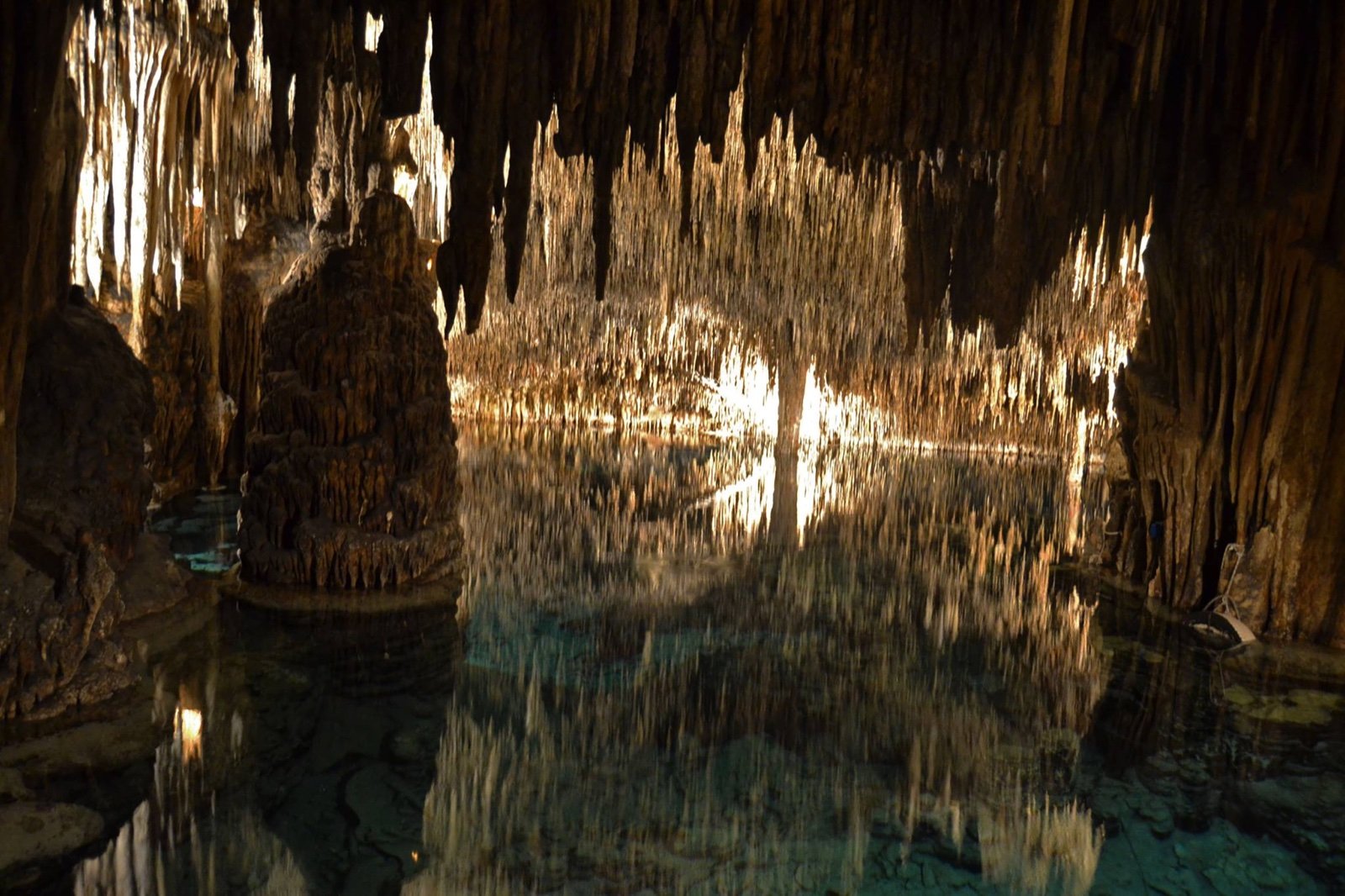 Drach CavesSpainSee hotels
Which kind of cave are you after?
The way in decides how long you stay underground, how many steps you climb and what you wear.
How to choose among the caves: six visits compared
Six caves side by side, with the operators’ own figures; the table of times, steps, depths and temperatures for every cave on this page follows.
| Cave | Country | How you visit | Adult price |
|---|
Caves by country, and where the painted ones are seen
France has the longest list on this page and its own page, Caves in France; the other countries are reached from the destinations page, and caves sit among the natural sites.
France
Padirac, Aven Armand and two replicas: Lascaux IV at Montignac, the facsimile of the entire cave opened in 2016 (€23 in 2026), and Grotte Chauvet 2 at Vallon-Pont-d’Arc, the walls reproduced to the millimetre.
Slovenia and Austria
Postojna and Škocjan, both reached by motorway from Ljubljana or Koper; Eisriesenwelt above Werfen, the Dachstein cave above Obertraun.
When to come, and what the cold means
Temperature changes little inside a cave, so the season is set above ground: opening dates, the state of the sea, rain and crowds.
Constant temperature
From -2 °C in the Dachstein ice to 19 °C at Nerja, 10 °C at Postojna, 13 °C at Padirac; a warm layer and shoes with grip.
Seasonal caves
Eisriesenwelt and the Dachstein Giant Ice Cave open from 1 May to 1 November in 2026, Padirac and Aven Armand from spring to 1 November; Postojna, Nerja and Cueva de los Verdes open all year.
Crowds
July, August, bank-holiday weekends and rainy days; Padirac sells online alone on its busiest days, and Nerja is quietest from 10 am to 11.30 am.
Free or paid
Admission charged
Drach Caves (€18.50 in 2026).
Children, pushchairs and wheelchairs
Steps decide most of it; the operators say where the line falls.
Pushchairs
Stay outside at Padirac, Han-sur-Lesse, Aven Armand, Lascaux IV and Cueva de los Verdes: bring a baby carrier. Postojna takes a folding stroller on the train; Grotte Chauvet 2 admits them throughout.
Wheelchairs
The whole of Grotte Chauvet 2 is accessible, as are the Lascaux IV route and the Altamira museum; at Waitomo, Ruakuri takes chairs up to 65 cm wide and the Glowworm Cave none; Postojna advises the train alone, with two days’ notice.
Age
No minimum at the Dachstein Giant Ice Cave; an adult with children of 14 and under at Postojna and in the Blue Grotto.
Frequently asked questions
How long does a cave tour take?
From 40 minutes to about three hours. Most show caves on this page take around an hour: 50 minutes at Cueva de los Verdes and in the Dachstein Giant Ice Cave, about 1 h 30 at Postojna and Padirac, 2 h 30 to 3 h for the 3.1 mi of the Škocjan Caves, and about three hours from the car park and back at Eisriesenwelt. The table of figures above gives the operator’s time for every cave.
What should you wear to visit a cave?
A warm layer and closed shoes with grip, even in August: 10 °C at Postojna, 12 °C at Škocjan, 13 °C at Padirac, 9 °C at Han-sur-Lesse, and below zero at Eisriesenwelt and in the Dachstein Giant Ice Cave. Nerja, at 19 °C, is the warm exception, and it refuses flip-flops, heels and sandals without straps.
Do you need to book a cave visit in advance?
Often. Cueva de los Verdes sells its ticket online for a set date and time, Waitomo states that pre-booking is essential, Lascaux IV works on timed tickets, and Padirac says that an online booking is the one guarantee of entry and sells online alone on its busiest days. Postojna and Škocjan sell at the desk too, but summer tours sell out on some days.
Can you visit Lascaux, Chauvet or Altamira?
Not the original caves. Lascaux has been closed since 1963 and Chauvet has never opened to the public: you visit Lascaux IV at Montignac and Grotte Chauvet 2 at Vallon-Pont-d’Arc, two facsimiles with the works at full scale. Altamira admits at most five people a week from a closed waiting list; everyone else sees the Neocueva for €3.
Which caves can you visit by boat?
Padirac, where a boatman steers you on the underground river 338 ft down; the Blue Grotto, entered lying flat in a rowing boat through a gap about 7 ft wide; and Waitomo, a 45-minute boat ride under the glowworms. Benagil is reached from the sea alone: since 13 August 2024 boats look in without landing, and swimming in is banned.
Are caves suitable for children?
Yes, with the steps in mind: 1,400 at Eisriesenwelt, about 1,000 at Škocjan, 458 at Nerja, 367 on the Découverte tour at Han-sur-Lesse. The Dachstein Giant Ice Cave sets no minimum age, Postojna and the Blue Grotto ask for an adult with children of 14 and under, and Lascaux IV runs a storytelling visit for ages 5 to 10 in school holidays. Pushchairs stay outside almost everywhere: bring a baby carrier.