


Mount Etna
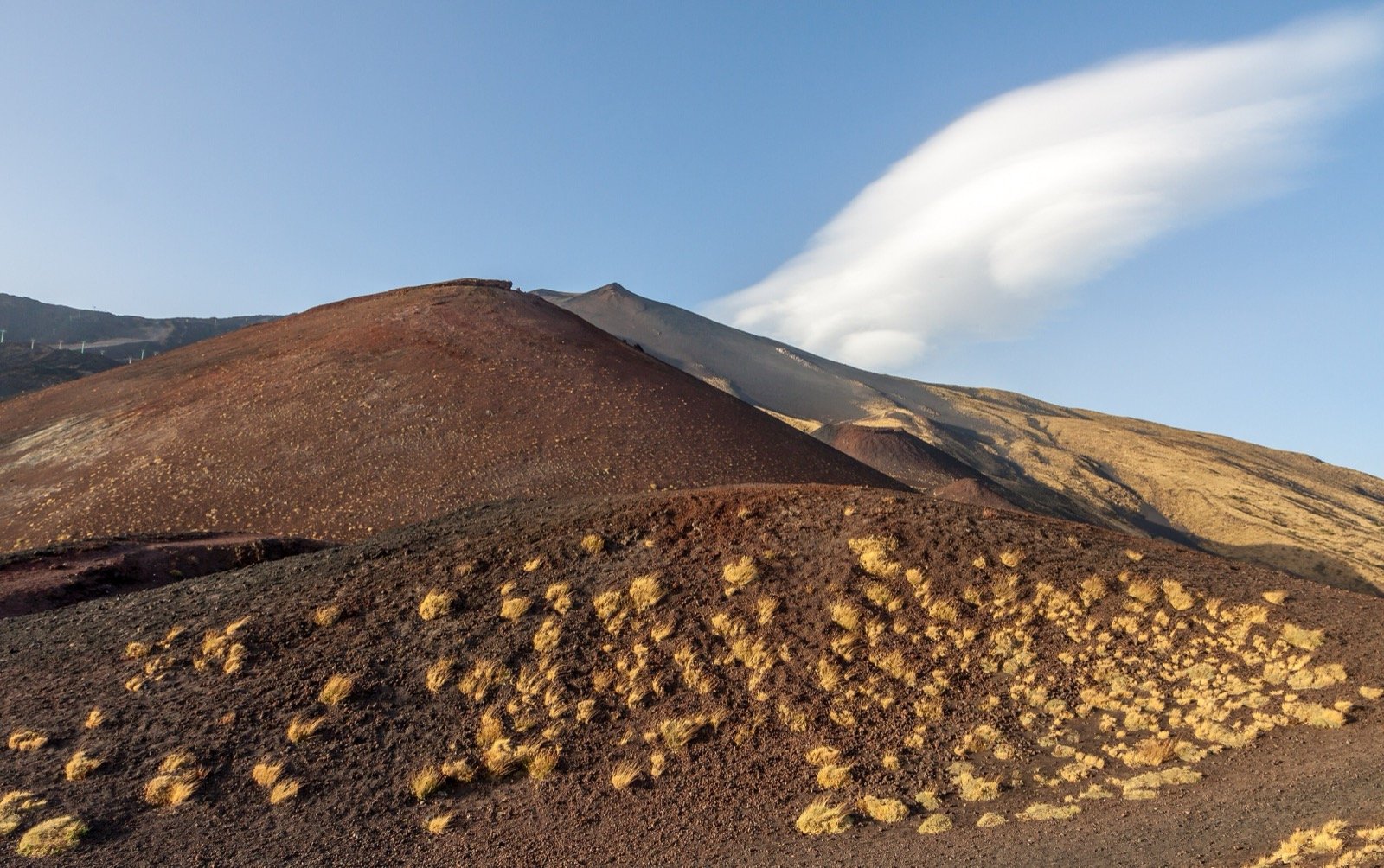
Sicily’s volcano, 3,403 m at the last INGV measurement, with at least 2,700 years of recorded eruptions. A cable car and 4x4 buses climb the south side; above 2,500 m, municipal ordinances decide who may go further.

At a glance
- 3,403 m at the INGV measurement of September 2024; the summit changes height with each eruption
- On the World Heritage list since 2013, for at least 2,700 years of documented eruptions
- Summit craters, and more than 300 vents on the flanks
- The only cable car on the volcano, from 1,920 m to 2,500 m
- Guided tours are advertised up to about 3,000 m, but whether they run depends on the alert phase
- The Permanent Danger Zone around the active craters is closed to everyone at 20 October 2026 (pre-alarm); in the attention phase it is open only with an authorised guide
Where to stay
Hotels, guesthouses and rentals around Mount Etna
Check availability with our partners
Affiliate links: if you book through them, we earn a commission. The price you pay does not change. How this site is funded
NicolosiClosest
9.3 mi as the crow flies
See hotels
Which tour to choose?
| Tour | Duration | Difficulty | Guided | Adult price |
|---|---|---|---|---|
| Crateri Silvestri | 30 min | Easy | €5 (2026) | |
| Sunsetna | 3 h | Easy | Yes | €82 (2026) |
| Tour 3000 | 2 h 30 min | Easy | Yes | €82 (2026) |
Facts checked on October 15, 2026
How the visit runs
Silvestri Craters, on the road up about 30 min
Signposted SILVESTRI CRATERS along the road to Rifugio Sapienza, two cones at 1,986 m and 1,886 m, reached straight from the provincial road.
Rifugio Sapienza, Etna Sud
The cable car leaves from the piazzale Rifugio Sapienza in the municipality of Nicolosi, at 1,920 m, the departure point of the south side.
Cable car to 2,500 m
The Etna cable car climbs to 2,500 m. At the upper station you can hire a jacket, boots and poles, and there is a snack bar with a terrace.
4x4 bus to 2,800 m
From 2,500 m, the operator’s 4x4 buses (a snowcat in winter) take the track to 2,800 m. The track belongs to the operator and only its vehicles use it.
On foot to 3,000 m with a guide, if it runs
A short guided walk is advertised up to about 3,000 m, past the Torre del Filosofo, the craters of 2002 and the view of the summit craters. At 20 October 2026 the pre-alarm is in force and no source confirms that this walk runs: ask the operator.
Etna’s alert phases on the south side
| Phase | Permanent Danger Zone | Summit zone above 2,500 m |
|---|---|---|
| Attention (activated 6 September 2025) | Authorised guide only, 10 walkers per guide, groups 15 minutes apart, 300 walkers a day at most | Helmet and mountain clothing compulsory |
| Pre-alarm (in force on 20 October 2026) | Closed to everyone, guides descend at once; the ordinance caps (300 walkers a day, 10 per guide) do not apply | No separate ban in the ordinance |
| Alarm (F2) | Closed to everyone | Closed to everyone, with the upper Valle del Bove: immediate evacuation |
Source: Comune di Belpasso, ordinance no. 135 of 10 August 2026, published by the Parco dell’Etna, still the reference for the south side. State on 20 October 2026: pre-alarm, restored on 20 August 2026 and again on 12 October 2026 after an alarm of about 11 hours, with the Permanent Danger Zone closed to everyone; the Bronte ordinance no. 100 of 14 August 2026 also suspends all excursions in that zone. The phase is set by the regional civil protection: check it on the day, as no source says when the zone will reopen.
Before you go
- Helmet and mountain clothing are compulsory for everyone at high altitude, under the Belpasso ordinance of 10 August 2026.
- A guide is required to enter the Permanent Danger Zone when it is open (attention phase): an authorised alpine or volcanological guide. At 20 October 2026 the zone is closed to everyone (pre-alarm, notice of 12 October 2026).
- Footwear: the operator advises hiking shoes and a windproof jacket.
- Health: the operator advises against the trip for people with heart or respiratory conditions, high blood pressure, and during pregnancy.
- Drones and bulky luggage are not allowed on the cable car tours; dogs go on a lead and wearing a muzzle.
- Reduced mobility: the 4x4 buses have a ramp, and a stairlift serves the ticket office.
- Cable car hours: every day from 8:30 to 16:45, last descent at 17:15, weather permitting, as published by the operator in October 2026.
- Closed trails: park trails marked “non in esercizio” are off-limits to the public.
What is allowed
| Topic | Rule | Source |
|---|---|---|
| Visitor quota | Restricted | Parco dell’Etna, Dipartimento regionale della Protezione civile (Sicilia), Parco dell’Etna (ordonnance du Comune di Belpasso) |
Rules checked with the site manager on October 20, 2026. They can change at short notice: check before you go.
How to get there
Mount EtnaGateway towns
Etna is the largest of Italy’s four active volcanoes, about two and a half times the height of Vesuvius. Its summit is never the same for long: 10,741 ft in 1900, 10,912 ft in 1950, 11,014 ft in 2021 and 11,165 ft after the paroxysms of 2024.
Mongibello, Typhon and a forge under the mountain
Sicilians call it Muncibbeḍḍu, Italians Mongibello. The name Etna may come from the Greek aíthō, to burn, or from a Phoenician word for a furnace. Myth gave it two tenants:
- the forge of Hephaestus, Vulcan to the Romans;
- the monster Typhon, trapped under the mountain by Zeus.
Lava that reached Catania and buried the observatory
Etna’s eruptions have been recorded for at least 2,700 years, one of the longest historical series in the world. Some of them reshaped the visit itself:
- 1669: the most destructive eruption since 122 BCE; the lava destroys at least ten villages and reaches Catania in five weeks.
- 1971: lava buries the Etna observatory and destroys the first cable car.
- 1983: it destroys the cable car again, with ski runs and the SP 92 road.
- 2001 and 2002-2003: flows destroy part of the Etna Sud station around Rifugio Sapienza, then the Piano Provenzana station on the north-east side.
On the eastern flank, the Valle del Bove, a vast depression left by a flank collapse thousands of years ago, is what the park calls a window on the volcano’s history.
The 2026 eruption and the state of the volcano
From 6 August 2026, activity intensified with successive lava fountains:
- four vents opened in the Valle del Bove, with flows down to about 4,265 ft;
- by mid-August, Strombolian activity resumed at the Voragine;
- the INGV bulletin of 13 October 2026 reported variable degassing, discontinuous ash from the North-East Crater, low seismicity and low volcanic tremor.
- on 12 October 2026, the regional civil protection raised the alarm phase for about 11 hours, then restored the pre-alarm the same day.
The INGV does not rule out a rapid shift towards eruption columns and pyroclastic flows. Its ETNAS rapid alert system, operational since 1 April 2022, watches for lava fountains and magma intrusions.
Safety: zones, ordinances and guides
The rules on the summit come from the municipalities, the regional civil protection and the INGV, not from a single park page. Two zones matter:
- the summit zone: the summit craters, the upper Valle del Bove down to 5,577 ft and everything above about 8,202 ft on the south, west and north sides;
- the Permanent Danger Zone, which contains the active craters and is regulated whatever the state of the volcano.
Twelve municipalities, from Adrano and Bronte to Nicolosi and Zafferana Etnea, publish their own ordinances, several dated July and August 2026. Guides must brief walkers on the risks, in English too, collect a signed waiver, supply a helmet if needed and stay in radio contact. Check the current phase with the regional civil protection before going up.
At 20 October 2026 the phase is pre-alarm (restored on 20 August 2026, and again on 12 October after an alarm of about 11 hours) and the Permanent Danger Zone is closed to everyone. The ETNAS levels (F0, F1, F2) measure the volcano’s activity, whereas the phases (attention, pre-alarm, alarm) are set by the civil protection: a return to level F0 does not end the pre-alarm.
Frequently asked questions
Can you hike to the summit of Mount Etna without a guide?
No. At 20 October 2026 the Permanent Danger Zone around the summit craters is closed to everyone: the pre-alarm phase has been in force since notice no. 2 of the regional civil protection on 12 October 2026, and the Bronte ordinance no. 100 of 14 August 2026 suspends all excursions there. In the attention phase only, the Belpasso ordinance no. 135 of 10 August 2026 allows entry with an authorised alpine or volcanological guide; each municipality on the volcano publishes its own ordinance. Check the phase with the regional civil protection before going up: no source gives a reopening date.
How much is the Etna cable car?
€54 online for the Fast Track return to 2,500 m, as displayed in October 2026. The Tour 3000, with the 4x4 bus and a guide up to 3,000 m, was listed at €82.
How high can you go on Mount Etna?
About 3,000 m on the guided tours advertised by the cable car operator, which presents it as the maximum altitude the authorities allow. At 20 October 2026 the pre-alarm is in force and no source confirms that the walk to 3,000 m runs: ask the operator. The summit itself stood at 3,403 m in September 2024.
Is Mount Etna erupting right now?
In the week of 5 to 11 October 2026, the INGV reported variable degassing from the summit craters and discontinuous ash emissions from the North-East Crater, with low seismicity. The activity had intensified from 6 August 2026 with lava fountains. On 12 October 2026 the regional civil protection raised the alarm phase for about 11 hours before restoring the pre-alarm, still in force on 20 October 2026.
How long is the Tour 3000 on Etna?
About 2 hours 30 minutes when it runs: cable car, 4x4 bus to 2,800 m, then a short guided walk to 3,000 m. The guides speak Italian, English and French.
Can you ski on Mount Etna?
Yes. Etna Sud (Nicolosi, Rifugio Sapienza) and Etna Nord (Piano Provenzana, Linguaglossa) generally open from mid-December to late spring, depending on the snow.
Sources
13 sources
- Funivia dell’Etna consulted on October 15, 2026
- Parco dell’Etna consulted on October 20, 2026
- Parco dell’Etna (ordonnance du Comune di Belpasso) consulted on October 15, 2026
- Parco dell’Etna (sito UNESCO) consulted on October 15, 2026
- Dipartimento regionale della Protezione civile (Sicilia) consulted on October 20, 2026
- INGV Osservatorio Etneo consulted on October 15, 2026
- OpenStreetMap consulted on October 15, 2026
- Wikidata consulted on October 15, 2026
- Wikipedia (de) consulted on October 15, 2026
- Wikipedia (en) consulted on October 20, 2026
- Wikipedia (es) consulted on October 15, 2026
- Wikipedia (fr) consulted on October 15, 2026
- Wikipedia (it) consulted on October 15, 2026